FLIPP · CASE STUDY 01
Loyalty Cards
Making digital loyalty cards easy to add — so more shoppers could clip coupons and save at checkout.
TIMELINE
2019
ROLE
Senior Product Designer
TEAM
Utility of Content squad
IMPACT
+7% weekly loyalty-card adds
OVERVIEW
Coupons that only work if the card is added.
In the U.S., Flipp shoppers load digital coupons onto a store loyalty card; scanning that card at checkout applies every discount automatically. Flipp supported retailers like CVS, Walgreens, Family Dollar, and Target — but adding the card in the first place was hard to discover, unclear to complete, and gated behind a login. The whole savings loop depended on a step most people never finished.
THE CHALLENGE
Clip 5× more coupons.
The Utility of Content team set a goal to grow coupon clipping fivefold. That pointed at two design questions.
01
Discoverability
How might we make adding a loyalty card easy to find, at the moments it matters?
02
Friction
How might we strip the steps — especially the login gate — out of the flow?
My hypothesis: educational nudges at multiple touchpoints would improve discoverability, the required Google/Facebook login was quietly driving abandonment, and a clear, expectation-setting flow would get more cards added.
EXISTING FLOW
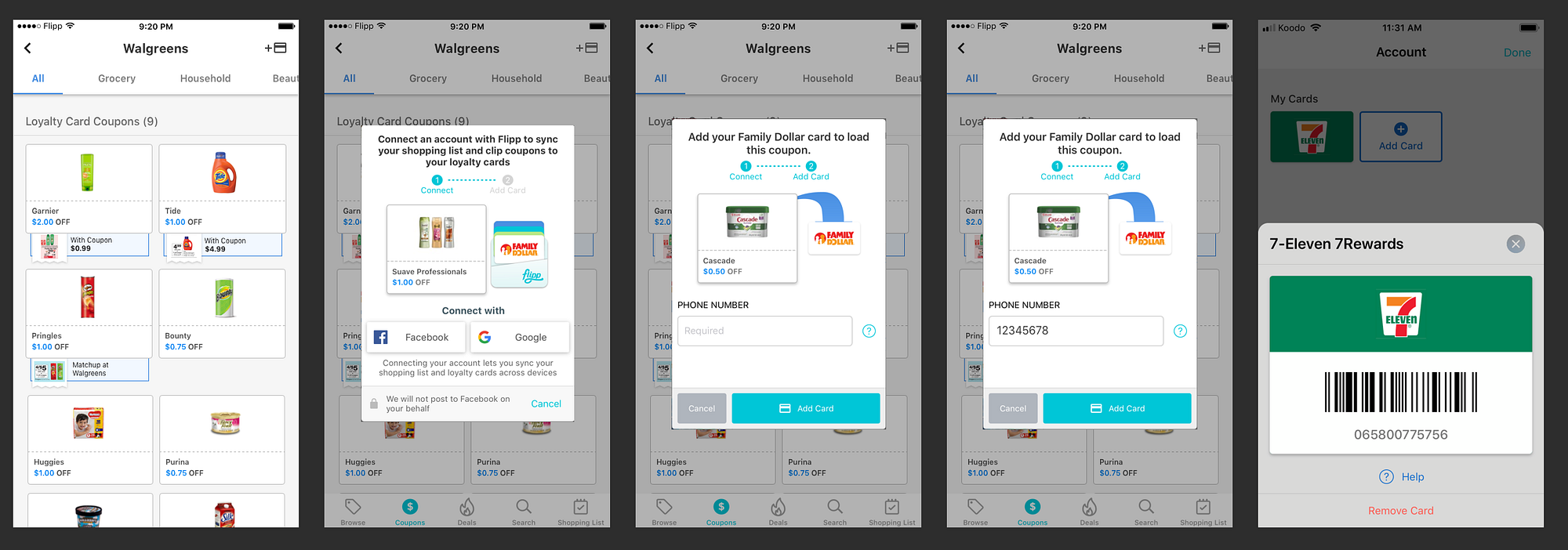
A login wall in front of a savings feature.
The old flow asked people to connect an account with Facebook or Google before they could add a card — a privacy ask that stopped many shoppers cold, for a task that shouldn't have needed an account at all.
EXPLORATIONS
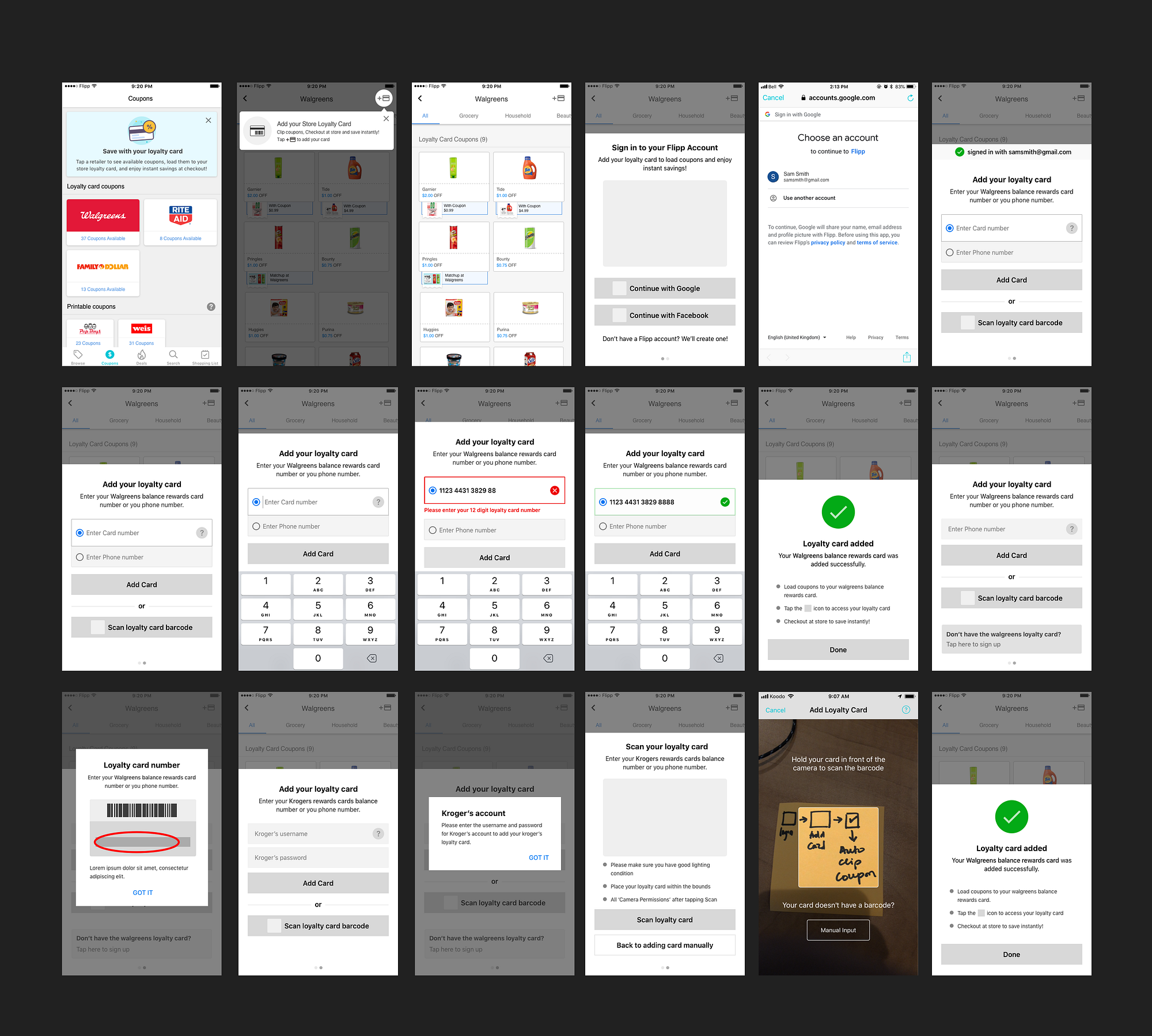
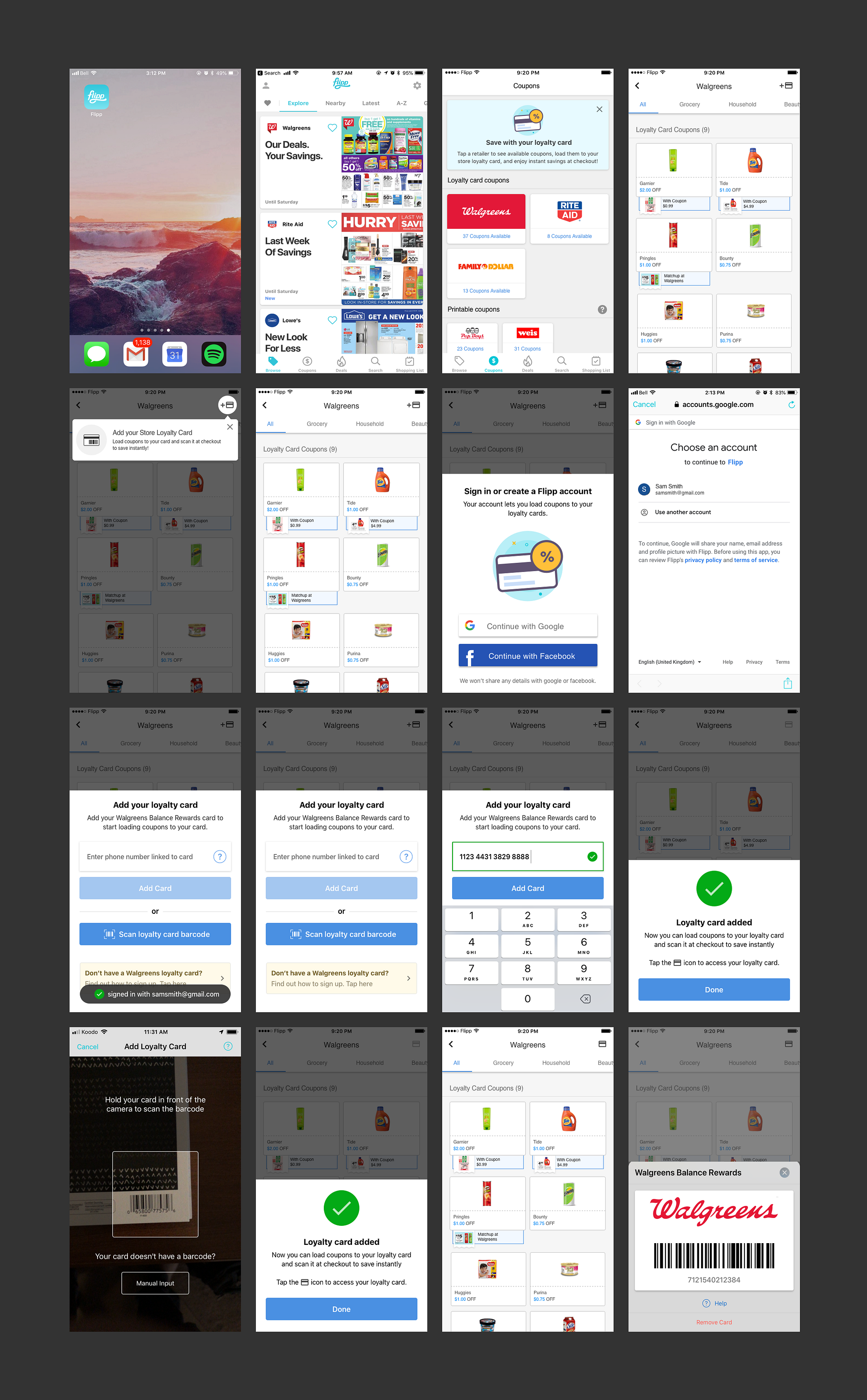
Every path, every edge, every message.
I wireframed the full journey — card number, phone number, single sign-on, and barcode scan — along with the educational states, error and feedback messaging, and the edge cases that decide whether a flow feels trustworthy.
VALIDATION
Ten people, two questions answered.
I built an InVision prototype and tested it on usertesting.com with ten participants — five existing U.S. Flipp users who'd used loyalty coupons before, and five new users familiar with rivals like Checkout51, Ebates, and Ibotta.
The proposed flow beat both the old Flipp experience and the competitors. Barcode scanning and phone-number entry were the preferred methods, and nearly everyone said they'd use it — one put it plainly: "Our keychains would now be lighter. I won't have to carry all my cards." Just as clearly, participants unanimously rejected the social-login requirement, and expected to see their card and all clipped coupons together in one place.
SHIPPED
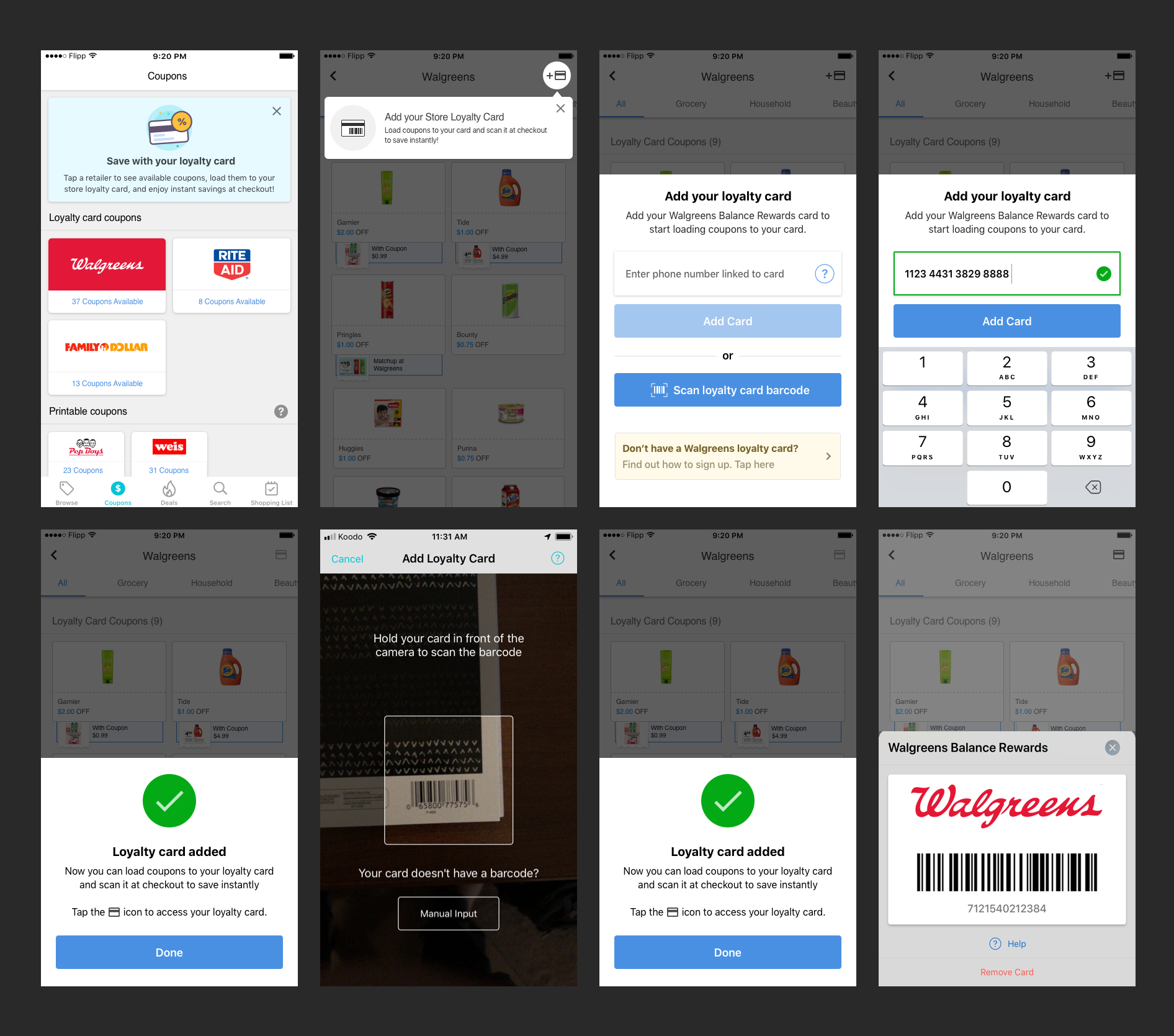
Add a card in seconds — no account required.
The shipped flow lets shoppers add a card by number, phone, or barcode scan, with clear success states and no login gate. I also recommended decoupling login from features entirely once email sign-up existed, and introducing account creation later — after the value is obvious.
A HOME FOR COUPONS
Card and coupons, finally in one place.
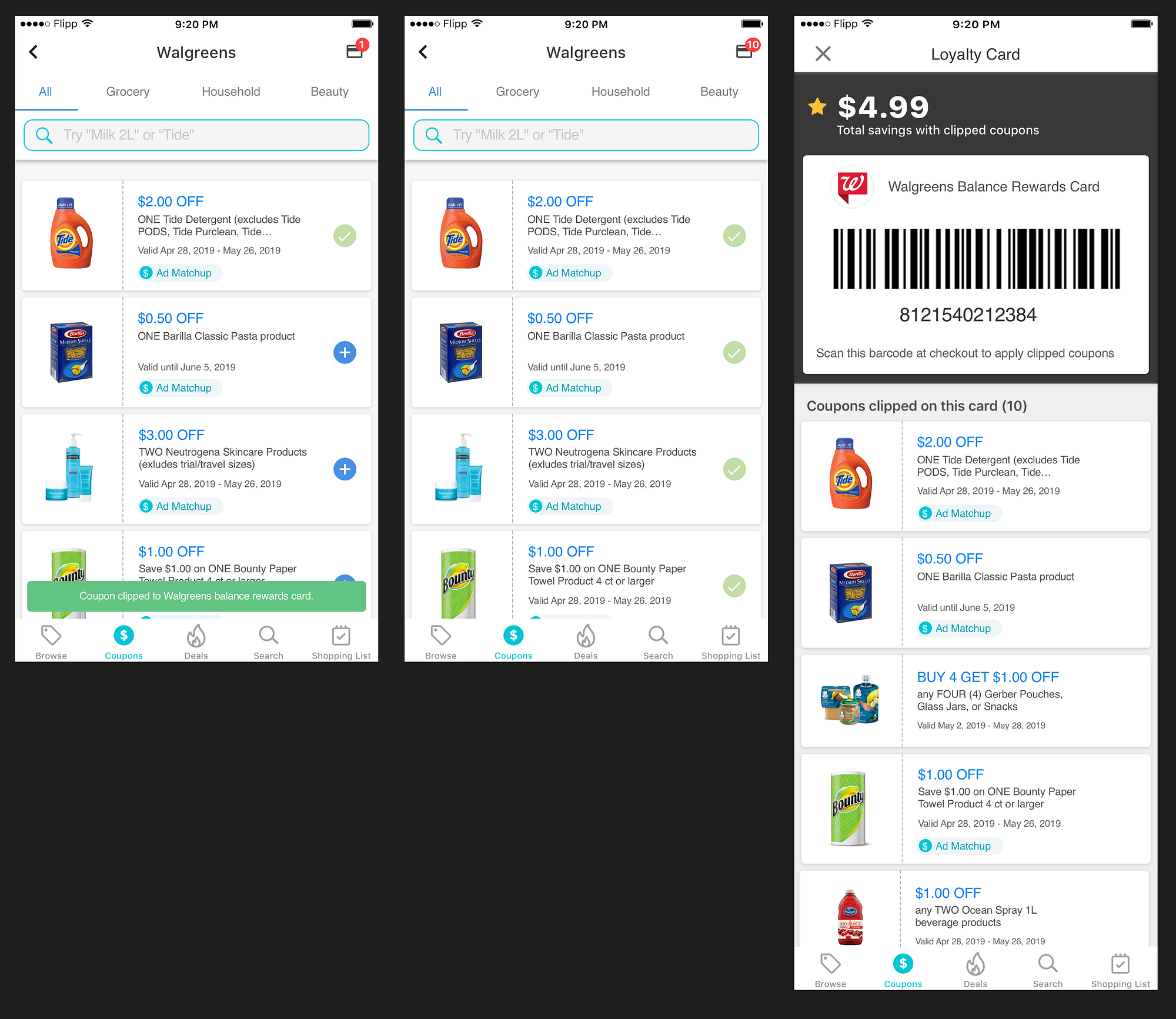
Testing said people wanted their card and their clipped coupons together — so I redesigned the final screen into a dedicated coupons hub: a full-screen loyalty barcode, the coupons clipped to it, count badges, and a running total of potential savings to keep people coming back.
RESULTS
A 7% lift, from removing a wall.
After release, weekly loyalty-card adds and coupon clipping rose 7%. Taking down the login barrier and making the flow legible did most of the work — proof that the fastest way to grow a feature is often to stop blocking it.